A bad hire rarely looks like a bad hire at the start.
On paper, the candidate checks every box. The interview goes well. The experience looks right. But once the role begins, cracks start to show. Ramp-up is slower than expected. Communication feels off. The person struggles to keep pace with how decisions are made or how work actually gets done.
In 2026, hiring success depends less on resumes and more on alignment. Hiring mistakes are rarely obvious at the offer stage. In fact, research from Leadership IQ shows that 46% of newly hired employees fail within their first 18 months, not because they lack skills, but because they are a poor fit for how the work actually gets done.
Many bad hires look strong on paper and interview well, yet struggle once real expectations, pace, and accountability come into play. Avoiding a bad hire starts with changing how roles and candidates are evaluated before the offer is made.
What Is a “Bad Hire”?
A bad hire is not always someone who underperforms or fails outright. In many cases, the individual is capable, motivated, and experienced, yet still struggles to gain traction in the role.
Rather than obvious performance issues, bad hires more commonly reveal themselves through subtler signs that emerge after the start date. These challenges often reflect misalignment between the individual and the realities of the role, not a lack of ability.
More often, a bad hire shows up as:
- Slow ramp-up despite strong credentials
- Misalignment with expectations or work style
- Difficulty adapting to pace, structure, or decision-making norms
In 2026, success depends on how well someone fits the position and the environment in which the work is done. A candidate can be technically capable and still struggle if they are misaligned with how work actually gets done.
5 Ways to Avoid a Bad Hire
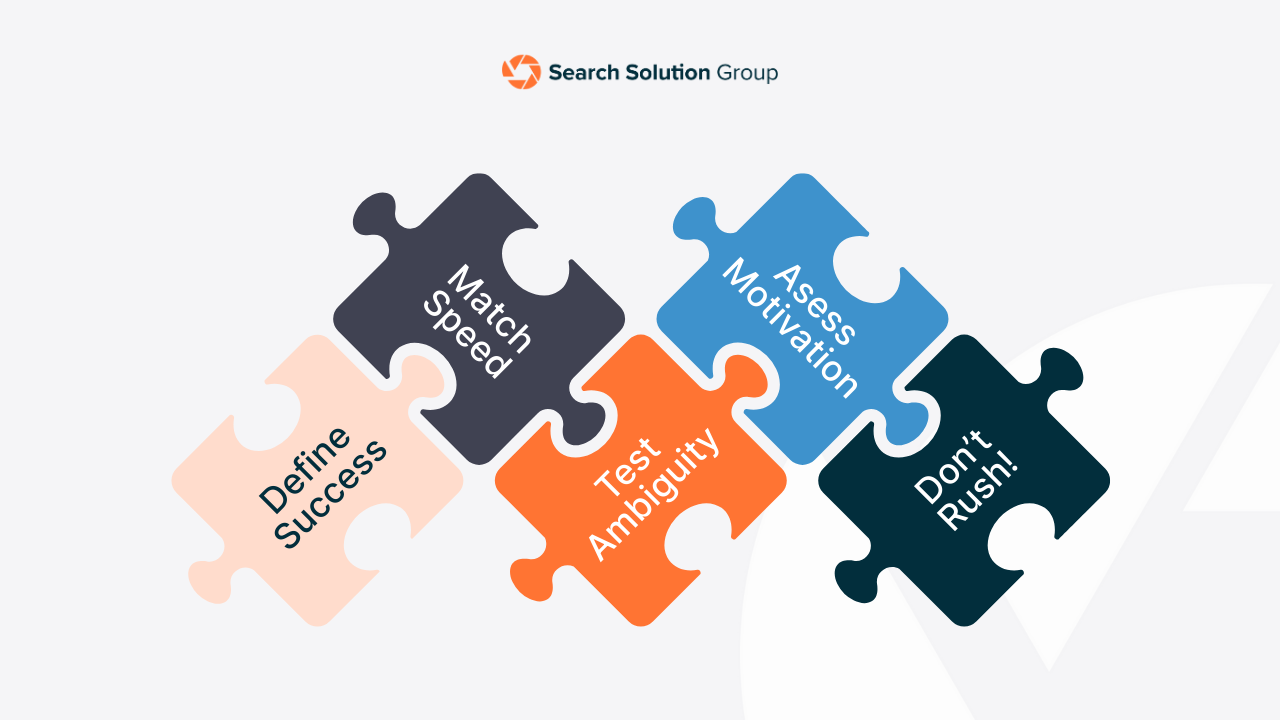
Tip 1: Define Success Before You Interview Anyone
Many bad hires happen because success was never clearly defined upfront. When expectations are vague or inconsistent, even strong candidates can struggle once they step into the role.
Before interviews begin, align internally on:
- What success looks like in the first 30, 60, and 90 days
- The specific problems the role is expected to solve
- How performance will be measured
- Where the role has authority versus dependency on others
Clear success criteria create more focused interviews and more objective evaluation.
Example:
If one interviewer expects strategic leadership while another expects hands-on execution, the candidate receives mixed signals and struggles to meet conflicting expectations after starting.
Tip 2: Hire for Pace, Not Just Capability
Capability alone is not enough. A candidate may have the right skills but still struggle if they cannot operate at the pace the role demands.
When evaluating pace, consider:
- Speed of decision-making required
- Volume and variety of work
- Level of urgency and pressure
- Frequency of changing priorities
Matching candidates to the pace of the role reduces early performance friction.
Example:
A candidate from a slower, approval-heavy environment may struggle in a fast-moving organization where decisions are expected quickly and priorities shift often.
Tip 3: Test How Candidates Handle Ambiguity
Few roles in 2026 come with complete clarity. Strong hires can move forward even when information is incomplete or expectations evolve.
Use interview questions to understand how candidates handle:
- Unclear priorities or changing direction
- Incomplete processes or documentation
- Limited guidance or structure
- Independent problem-solving
Candidates who require constant direction may struggle in dynamic environments.
Example:
Asking a candidate to describe a time they acted without clear instructions can reveal whether they are comfortable operating with uncertainty.
Tip 4: Pressure-Test Motivation, Not Just Interest
Interest can be rehearsed. Motivation determines long-term engagement.
Go deeper by exploring:
- What types of challenges energize the candidate
- What work environments drain them
- Why they are leaving their current role
- What they are hoping to gain in their next role
Misaligned motivation often shows up as disengagement within the first few months.
Example:
A candidate motivated by predictability may struggle in a role that requires building systems or navigating constant change.
Tip 5: Slow Down the Final Decision
Rushed hiring decisions increase risk and reduce clarity.
Before extending an offer:
- Review feedback patterns across interviewers
- Revisit any recurring concerns or red flags
- Compare finalists against previously successful hires
- Pressure-test assumptions made early in the process
A deliberate pause often reveals risks that are easy to miss when hiring feels urgent.
Example:
If multiple interviewers note concerns about communication or adaptability, slowing down to address those themes can prevent a costly hiring mistake.
How a Recruitment Firm Helps Reduce Hiring Risk
Even with a strong internal hiring process, identifying misalignment before it becomes a problem can be difficult. This is where the right recruitment partner adds value.
At Search Solution Group, our role goes beyond sourcing resumes. We work closely with hiring teams to bring clarity, structure, and objectivity to the hiring process before interviews even begin.
Our team helps organizations:
- Apply objective insight to candidate evaluation
- Identify potential misalignment early in the process
- Provide market context around expectations, compensation, and candidate availability
- Clarify what the role truly requires based on how the business operates today
By pressure-testing assumptions and asking the right questions upfront, Search Solution Group helps organizations make more confident hiring decisions and reduce the risk of costly hiring mistakes
Better Hiring Starts With Better Questions
Avoiding a bad hire is not about perfection. It is about clarity, alignment, and discipline.
The strongest hiring decisions are intentional, not reactive. Small changes in how roles are defined, candidates are evaluated, and decisions are made can significantly improve long-term outcomes.
In 2026, better hiring starts with understanding not just who a candidate is, but how they work, decide, and adapt once the job begins.